
In this article
- What panjeeri is and why it is a winter food
- Ingredients with quantities
- Step-by-step method
- Variations: jaggery, sugar-free and new-mother versions
- How to store panjeeri
- Serving ideas
- Ready-made option
- Questions people ask
Key takeaways
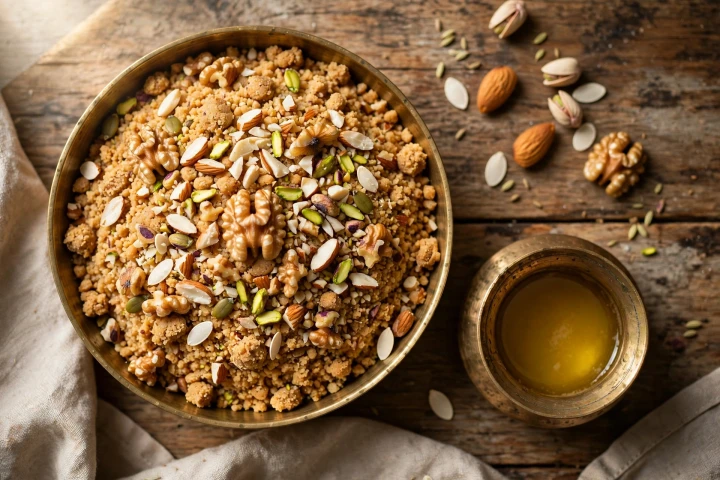
- Panjeeri is roasted whole wheat flour mixed with desi ghee, nuts, seeds, gond and cardamom.
- The flour must be roasted slowly on low heat until golden and fragrant — rushing it spoils the taste.
- Gond is fried separately in ghee until it puffs up, then crushed before mixing.
- Stored in an airtight jar, panjeeri keeps for weeks at room temperature and longer in the fridge.
- A small daily portion with warm milk is the traditional way to eat it in winter.
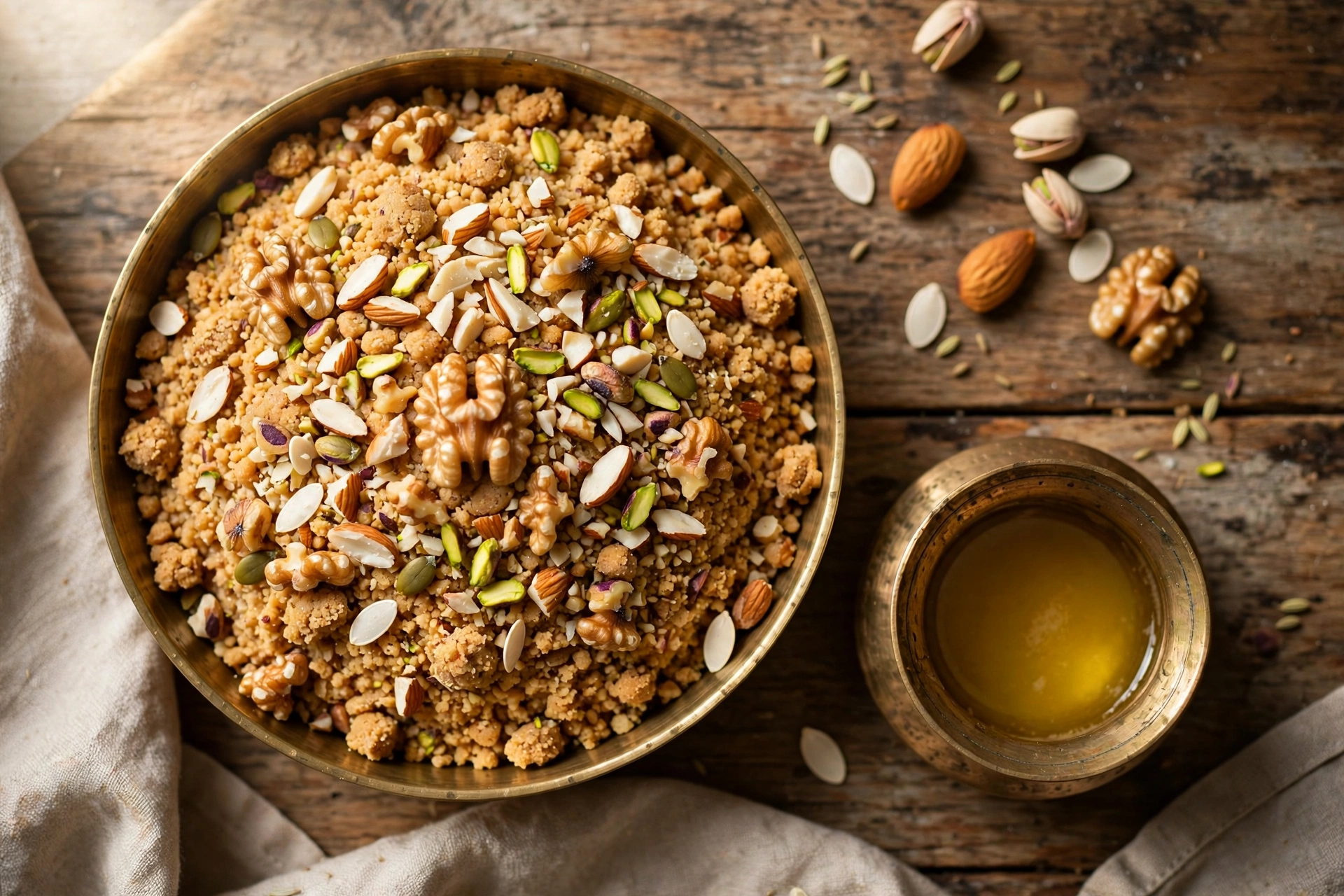
Direct answer: Panjeeri is a traditional Pakistani winter food made by slow-roasting whole wheat flour in desi ghee, then mixing in crushed almonds, walnuts, pistachios, gond, melon seeds and cardamom with sugar. It keeps for weeks in an airtight jar and is usually eaten in small portions with warm milk on cold mornings.
What Is Panjeeri and Why Is It a Winter Food?
Panjeeri is one of the oldest winter foods in Punjabi and Pakistani homes. It is not a dessert in the usual sense and it is not a medicine either. It is a dry, crumbly, energy-dense mix that families traditionally make in large batches when winter begins, because it stores well without a fridge and gives lasting warmth on cold mornings.
The logic is simple: roasted flour and ghee give slow energy, nuts and seeds add crunch, gond gives body, and cardamom and ginger add fragrance. A spoonful or two with warm milk was the standard winter breakfast long before packaged health foods existed.
Ingredients
This quantity makes roughly 1 kg of panjeeri, enough for a family for several weeks.
- Whole wheat flour (atta): 500 g
- Desi ghee: 250 g
- Sugar, finely powdered: 250 g (or jaggery, grated — see variations)
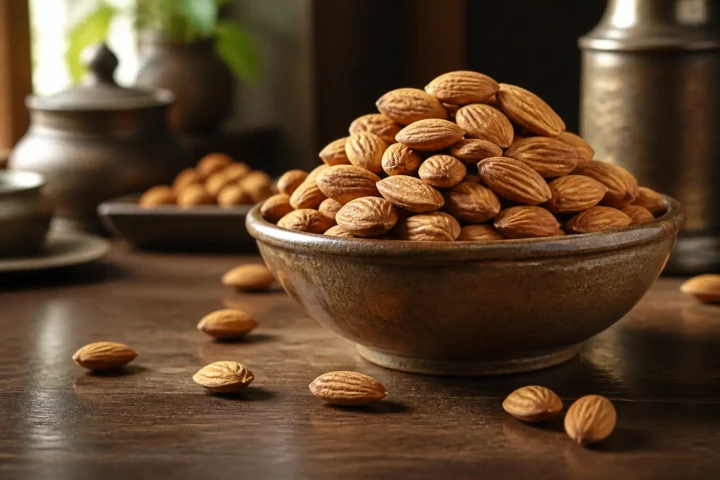
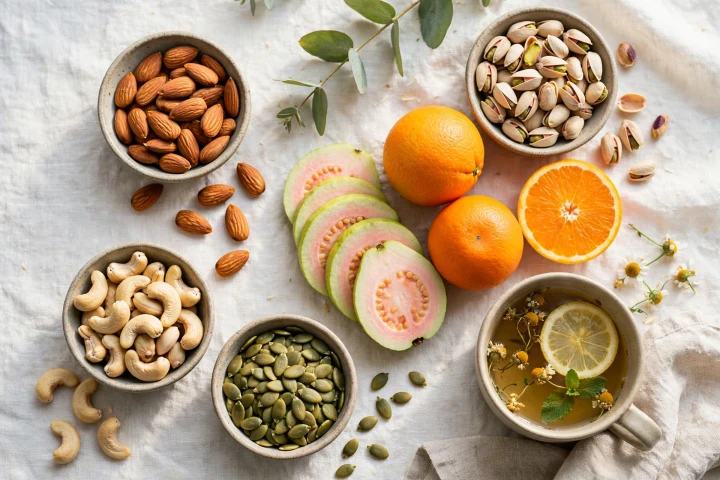
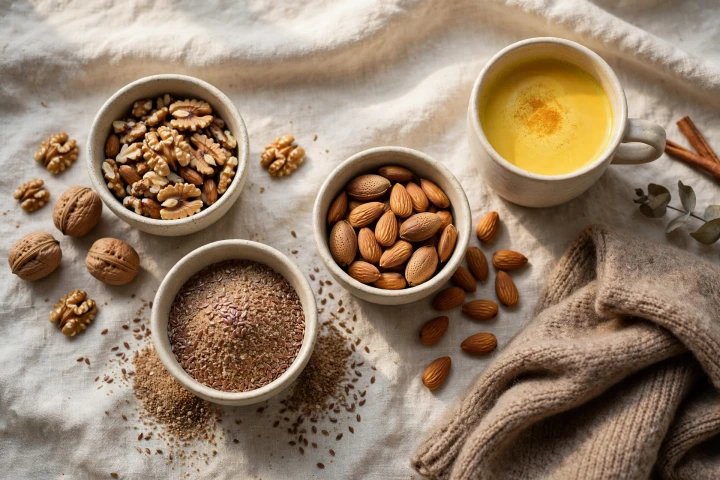
- Almonds: 100 g
- Walnuts (kernels): 100 g
- Pistachios: 50 g
- Cashews: 50 g
- Gond (edible gum): 50 g
- Char magaz (melon seeds): 50 g
- Pumpkin seeds: 50 g
- Desiccated coconut: 50 g
- Green cardamom powder: 1 teaspoon
- Dried ginger powder (sonth): 1 teaspoon (optional)
For the nuts, the almonds, walnuts, pistachios and cashews on the Khan Dry Fruits site are the usual pantry choices. Desi ghee is covered in the organic desi ghee range.
Step-by-Step Method
Step 1: Fry the gond
Heat 2 tablespoons of the ghee in a heavy karahi on medium heat. Add the gond in small batches. It will puff up within seconds like popcorn — remove it immediately before it darkens. Let it cool, then crush it lightly with a rolling pin or in a mortar. It should be in small crisp pieces, not powder.
Step 2: Roast the nuts and seeds
In the same karahi, dry-roast the almonds, walnuts, pistachios, cashews, char magaz and pumpkin seeds for 3–4 minutes on low heat, stirring constantly, until they smell toasted. Cool completely, then chop the nuts roughly. Do not grind them fine — panjeeri should have visible nut pieces.
Step 3: Roast the flour
Add the remaining ghee to the karahi on the lowest possible heat. Add the flour and roast, stirring continuously, for 20–25 minutes. The flour will first clump, then loosen, then turn a warm golden colour and release a nutty aroma. This is the step that decides the final taste. If the heat is too high, the flour burns and the whole batch tastes bitter, so patience matters more than speed.
Step 4: Mix everything
Take the karahi off the heat and let the roasted flour cool for 10 minutes — it should be warm, not hot. Add the crushed gond, chopped nuts, seeds, desiccated coconut, cardamom powder and dried ginger powder. Mix well. Finally add the powdered sugar and mix again until evenly combined. Adding sugar to very hot flour makes it melt and clump, which is why the cooling step matters.
Step 5: Cool and store
Cool completely on a wide plate, then transfer to a clean, dry, airtight jar. Any moisture will spoil the batch early, so jar and spoon must both be fully dry.
Variations
Jaggery panjeeri: Replace the powdered sugar with finely grated jaggery (gur), added while the flour is still slightly warm so it blends in. The taste is deeper and less sweet-sharp than sugar panjeeri.
Dates-sweetened panjeeri: Some families skip refined sugar and mix in finely chopped soft dates instead. The mixture becomes slightly stickier and must be eaten sooner, so make a smaller batch.
New-mother panjeeri: Traditionally, the version made for new mothers uses more gond and ghee and sometimes adds ajwain. This is a family tradition, not medical guidance — diet after delivery should follow your doctor's advice.
How to Store Panjeeri
Panjeeri is a dry mix, so storage is straightforward: airtight jar, cool dark shelf, dry spoon every time. At room temperature in winter it comfortably lasts 4–6 weeks; in the fridge it lasts several months. The same principles apply to all dry fruit at home — the storage guide explains why air, moisture, heat and light are the four enemies of freshness, and why oily nuts like walnuts deserve the fridge.
Throw a batch away if it smells of old oil, tastes bitter, or shows any mould. A dry mix does not improve with age.
How to Serve Panjeeri
Classic serving: 2–3 tablespoons with a cup of warm milk at breakfast. It also works sprinkled over porridge, as a travel snack, or as a yoghurt topping. Because it is rich, a small portion is enough.
Ready-Made Option
If roasting flour for half an hour sounds like too much work, the store's ready-made Desi Ghee Panjiri gives the same traditional mix without the cooking. You can find it through the Khan Dry Fruits home page and the desi ghee range. Prices always follow the live product page.
Questions People Ask
How long does homemade panjeeri last?
In a dry airtight jar at room temperature, 4–6 weeks in winter. In the fridge, several months. Always use a dry spoon, and discard it if it smells of stale oil.
Why did my panjeeri turn bitter?
Almost always because the flour was roasted on too high a heat. Roast on the lowest flame and stir continuously. Once flour burns, the bitterness cannot be fixed.
Can I make panjeeri without gond?
Yes. Gond adds body and the traditional texture, but the recipe still works without it. Add a little extra chopped nuts to make up the bulk.
Is panjeeri suitable for children?
In small portions with warm milk, it is a traditional family food. For very young children, make sure the nut pieces are finely chopped, and follow your doctor's guidance on nuts for toddlers.
Can I use jaggery instead of sugar?
Yes — finely grated jaggery is a popular variation and gives a deeper flavour. Add it while the flour is still slightly warm so it mixes evenly.
Sources and further reading
- USDA FoodData Central (fdc.nal.usda.gov) — nutrient composition of almonds, walnuts, pistachios, pumpkin seeds and wheat flour.
- Khan Dry Fruits storage guide: Dry Fruits Ko Taza Rakhne Ka Tarika.
- The recipe method itself is the traditional Punjabi home method, as cooked in Pakistani households for generations; no single published source is claimed for it.
Related guides: Khan Dry Fruits blog | Dried prunes guide
This article is for general information only, not medical advice. Prices always follow the live product page.